MVP App Development in 14 Days for Founders With Fixed Scope
An MVP is the smallest version of your app that lets real users complete one core task, so you learn whether the idea works before spending months building the rest. The fastest practical route: pick one user journey, lock the scope in writing, and run it through a short, senior-engineer build sprint rather than an open-ended agency engagement. Done right, you get live users, real usage data, and a clear go/no-go decision within a few weeks.
TL;DR:
- An MVP should focus on a single core user journey and be built with one engineer over two weeks, with scope locked in writing before development begins.
- Prioritize speed by choosing proven, managed technologies like monolithic frameworks and third-party services for authentication, payments, and hosting.
- Strict scope control with a single checkpoint and a written scope document is key, avoiding mid-sprint feature requests that cause delays.
- Launch success depends on measuring user activation and retention of the core action, with decisions made before analyzing the data to guide next steps.
- Fixed-price, productized MVPs from vendors like Kellosolutions deliver rapid results with full code ownership, ideal for testing demand without extensive management.
Table of Contents
- What Is an MVP in App Development, and Why Use One?
- The Step-by-Step MVP Development Process
- How Do You Choose What Goes Into the MVP?
- Technical Approach and Stack Choices That Speed Delivery
- No-Code, Productized Sprints, Agencies, or In-House: Which Fits?
- Testing, Store Requirements, and Compliance You Can’t Skip
- Launch, Measurement, and When to Iterate
- How Kellosolutions Delivers Rapid, Fixed-Price MVPs
- When Should You Actually Build an MVP?
- Build Your MVP With Kellosolutions
- Sources
- FAQ
What Is an MVP in App Development, and Why Use One?
An MVP (minimum viable product) exists to test a hypothesis, not to impress anyone. The lean startup model built around this idea has one job: help you learn whether people want what you’re building before you spend real money finding out the hard way. Success isn’t a polished app. It’s a decisive answer, ideally backed by paying users or a retention curve you can point to.
Founders often confuse three very different things:
- Proof of concept (PoC): proves a technical idea is feasible, usually never touched by a real customer.
- Prototype or mockup: a clickable design that shows the flow but runs no real logic or data.
- MVP: a working app with real backend logic that a stranger can download and use to solve their problem.
- Minimum lovable product (MLP): an MVP with just enough polish that early users actually enjoy it, not just tolerate it.
An MVP is the right move when you still have an open question about demand, willingness to pay, or usage behavior. If you already know the answer, you don’t need an MVP. You need to build the real product.
The Step-by-Step MVP Development Process
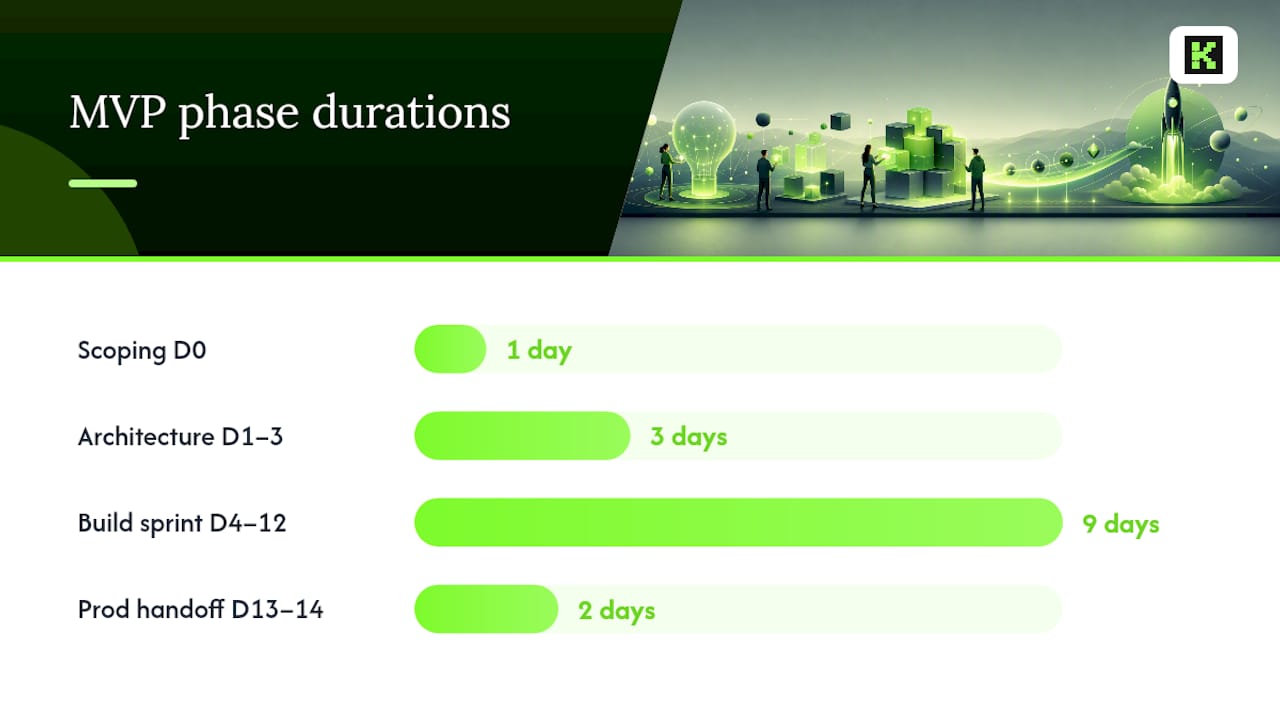
A good MVP process is boring on purpose. It follows the same sequence every time, with a deliverable at the end of each phase that you can point to and say “this is done.” A productized version of this process compresses everything into roughly two weeks, using four phases with fixed outputs: scoping, architecture, a senior-engineer build sprint, and production handoff.
Here’s how the phases break down in practice:
- Scoping (Day 0). You and the engineering lead write down exactly what the app does, who uses it, and what “done” looks like. This becomes a signed document, not a slide deck. Nothing gets built until this exists.
- Architecture (Days 1 to 3). The technical approach gets documented: database structure, third-party services, and how the pieces fit together. You should be able to read this and understand what you’re paying for.
- Build sprint (Days 4 to 12). A single senior engineer writes the core app end to end, deploying to a staging environment daily so you can watch progress rather than wait for a big reveal at the end.
- Production handoff (Days 13 to 14). You receive the full codebase, a recorded walkthrough, and whatever credentials or documentation you need to run the app without the original builder.
Who needs to show up for this? Not a committee. One founder or product owner who can make scope decisions fast, and one engineer who owns the build from day one to day fourteen. Every extra layer of approval or hand-off between team members adds delay without adding quality. Daily-deployed staging and single-engineer ownership are what let a two-week sprint work at all, because there’s no coordination tax between people passing work back and forth.
Scope control is where most MVP timelines actually die. The fix isn’t complicated, but it has to be enforced from day one:
- Put the scope in writing before any code gets written, with explicit examples of what’s included and what isn’t.
- Schedule one mid-sprint checkpoint, not five. Use it to confirm direction, not to introduce new features.
- Any request that shows up mid-build goes into a “scope bank” for the next phase instead of getting squeezed into the current one.
That discipline, a written scope locked on Day 0 and a scope bank for anything that comes up mid-sprint, is what separates teams that ship in two weeks from teams that ship in four months of the same two-week plan repeated with excuses attached.
Pro Tip: Before you sign off on a scoping document, read it out loud and count the features. If you can’t build the entire list in the days budgeted, cut features now, not on day nine when the engineer tells you it’s not going to happen.
How Do You Choose What Goes Into the MVP?
Start by mapping the single path a user takes from “I just heard about this app” to “I got the value I came for.” That’s your core user journey. Everything else, settings screens, admin dashboards, social sharing, is a distraction until the core journey works and people actually use it.
Pick one success metric before you build anything. Not five metrics. One.
A few prioritization methods keep this honest instead of political:
- User-story mapping lays out every step of the journey so you can see what’s core and what’s decoration.
- MoSCoW (must have, should have, could have, won’t have) forces a blunt conversation about what actually ships.
- RICE scoring (reach, impact, confidence, effort) works well when multiple stakeholders keep pitching features and you need a number to settle the argument.
- The “one happy path” rule: if a feature doesn’t sit on the main journey a first-time user takes, it doesn’t belong in version one.
When a stakeholder or investor asks for “just one more thing” mid-build, the answer is a scope bank, not a yes. Write the request down, tell them it’s evaluated for the next phase, and keep building. Pro Tip: If you can’t describe your MVP’s core journey in one sentence without an “and,” your scope is already too big.
Technical Approach and Stack Choices That Speed Delivery
Speed of iteration should decide every technical choice you make for an MVP, not theoretical scale you don’t have yet. That means one deployable monolith instead of a web of microservices, and managed services wherever you can buy instead of build. MVP engineering guidance consistently points the same direction: pick proven, boring technology so your actual innovation stays focused on the product, not the plumbing underneath it.
In practice, that looks like:
- A single monolith app (something like Next.js or Laravel) rather than separate services for every function.
- A managed database (PostgreSQL is the common default) instead of a custom data layer.
- Managed hosting (Vercel or Railway, for example) instead of self-managed servers.
- Third-party services for auth, payments (Stripe is the standard reference point), and error tracking (Sentry) instead of building any of that from scratch.
None of this is about being cheap. It’s about not spending three of your fourteen days building a login system when a managed auth service does it better and faster. Cloud adoption frameworks reinforce the same principle: architecture decisions should match your actual operational maturity and iteration cadence, not the scale you hope to have in three years.
On testing, don’t try to cover the whole app. Write automated tests only for the core user workflow, the thing your success metric depends on, and keep that suite running in under 60 seconds so it doesn’t slow down daily deployment. Pair that with continuous integration and continuous deployment (CI/CD) so every commit reaches staging automatically, and you get the daily visibility that makes a fast build sprint possible in the first place.
No-Code, Productized Sprints, Agencies, or In-House: Which Fits?
Each sourcing model solves a different problem, and picking the wrong one is the most expensive mistake founders make before writing a line of code.
- No-code tools work well for a landing page test or a simple internal tool, but they hit a wall fast once you need custom logic, complex integrations, or full ownership of your codebase.
- A productized senior-engineer sprint (a fixed two-week build with one engineer, one price, one deliverable) suits founders who know their core journey and want speed without managing a team.
- A traditional agency brings more hands and more process, useful for larger scope, but usually means longer timelines, layered approvals, and pricing that shifts as requirements evolve.
- In-house hiring gives you full control and long-term ownership, but it’s slow to staff and expensive to sustain for a single MVP test.
IP and handoff matter more than founders expect going in. Before you sign anything, confirm in writing that you own the full codebase, receive complete documentation, and aren’t locked into the vendor for every future change. A vendor who won’t hand over clean, documented code isn’t building you an asset. They’re building themselves a retainer.
Testing, Store Requirements, and Compliance You Can’t Skip
Platform rules, not your code, are the most common reason a finished MVP doesn’t launch on schedule. Plan for these before you write a single test case, not after your engineer says the app is “done.”
On Android, Google Play requires new personal developer accounts created after November 13, 2023, to run a closed test with at least 12 continuously opted-in testers for 14 straight days before they can even apply for production access. That’s not a suggestion. Miss the tester count or let participation lapse, and the clock resets.
On iOS, Apple requires developers to declare their privacy practices in App Store Connect and request permission through AppTrackingTransparency whenever the app tracks users across other apps or websites. Skipping this, or misrepresenting what your third-party SDKs collect, is a fast way to get flagged during review.
Apple’s own review guidelines flag a handful of avoidable issues that stall approval every day: broken demo flows, placeholder content, and apps that aren’t functionally complete at submission. Build your QA checklist around these before you submit:
- Working demo account or demo mode ready for the reviewer.
- Every third-party SDK disclosed accurately in your privacy declarations.
- No placeholder text, broken links, or unfinished screens anywhere in the submitted build.
- Closed-test tester list confirmed and stable for the full 14-day window on Android.
The 12-tester, 14-day rule is easy to underestimate. If you’re not actively recruiting testers the day your build lands in a closed track, you’ll lose a week you didn’t budget for.
Launch, Measurement, and When to Iterate
Launch day isn’t the finish line. It’s the start of the actual experiment your MVP was built to run. Whatever your single success metric was, activation rate, conversion on the core action, day-seven retention, that’s the number you watch first, not downloads or app store ranking.
Before launch, instrument the app to answer three questions automatically: who signed up, who reached the core action, and who came back. Basic event tracking on the core journey and a simple in-app feedback prompt cover most of what an early-stage app needs. Skip the dashboard sprawl. You need five numbers you check daily, not fifty you check never.
Set your decision thresholds before you see any data, because it’s much harder to be honest about a number once it’s staring back at you:
- Continue building if the core action is completing at a rate that matches or beats your pre-launch target.
- Iterate the flow if users are activating but dropping before the core action, usually a sign of friction, not a bad idea.
- Pivot or stop if activation itself is weak after a real marketing push, that’s usually a demand signal, not an execution problem.
Pro Tip: Talk to your first ten users directly, by call or message, not just through analytics. Numbers tell you what happened. A five-minute conversation tells you why, which is the part that actually changes your roadmap.
How Kellosolutions Delivers Rapid, Fixed-Price MVPs
Kellosolutions runs the productized model described throughout this article: one senior engineer owns your build end to end, scope gets locked in writing before work starts, and you get a fixed price instead of a moving estimate. There’s no bench of junior developers and no management layer between you and the person writing your code.
What that looks like in practice for a client:
- A dedicated point of contact throughout the project, so you’re never chasing down whoever picks up the message.
- A fast reply time, which matters when a scope question is holding up a build day.
- A high client retention rate, reflecting delivery that matches what was promised.
- Full handoff documentation and codebase ownership at the end, not a black box you have to pay to unlock later.
If you already know your core user journey and want it built fast without managing a team, this model fits. If you’re still exploring whether you even need custom development, the app builder lets you assemble a working MVP yourself before committing to a build.
When Should You Actually Build an MVP?
Run an MVP when you have a real, unanswered question about demand, pricing, or user behavior, and a working app is the fastest way to answer it. Skip it, or slow down, when your product touches regulated territory (health data, financial transactions, anything with legal liability attached) because “ship fast and learn” doesn’t mix well with compliance review cycles that take longer than your build sprint.
For most founders, a productized two-week sprint beats a longer engagement, simply because you get an answer faster and at lower cost if the answer is no. Save the longer, more involved engagement for after you’ve validated the core hypothesis and need to build out the real product. Expect your first MVP to produce a decision, not a finished business. That’s the win.
— Ints
Build Your MVP With Kellosolutions
If you’ve read this far, you already know the fastest MVPs come from one senior engineer, a locked scope, and a fixed price, not a shifting quote from an agency juggling five other clients. That’s the exact model Kellosolutions runs on: you deal directly with a senior engineer for the whole project, get a fixed price up front, and have one accountable contact from the first call to the final handoff.
First contact starts with a scoping call, not a sales pitch. You walk through your core user journey, Kellosolutions turns it into a written scope document with a fixed delivery date, and the build starts once you sign off. No hidden costs, no vague timeline that quietly slips by a month. If you’d rather test the waters before committing to a full build, the MVP builder lets you assemble a working app in your browser for a one-time fee. For a custom build, check Kellosolutions’ services and start your scoping call today.
Sources
- App testing requirements for new personal developer accounts - Play Console Help
- User privacy and data use - App Store - Apple Developer
- MVP Software Development — Stack, Architecture & Process | MVPable
FAQ
What Is an MVP in App Development?
An MVP is the smallest working version of an app that lets a real user complete one core task, built specifically to test whether your idea has demand before you invest in the full product. It’s a functioning app with real logic, not a mockup or a technical proof of concept.
How Much Does It Cost to Develop an MVP App?
Costs vary widely depending on scope, platform, and who builds it, ranging from a few hundred dollars for a no-code test to tens of thousands for a custom-built app with backend logic. Kellosolutions’ app builder offers a self-serve option at a flat €89 one-time price, while custom senior-engineer builds are quoted after a scoping call through Kellosolutions’ services.
How Do I Develop a Mobile App MVP?
Start by mapping one core user journey and picking a single success metric, then move through scoping, architecture, a build sprint, and handoff. A productized process can compress that entire sequence into about two weeks with fixed deliverables at each phase.
What Is the Difference Between MLP and MVP?
An MVP proves the core function works and answers a demand question, while an MLP (minimum lovable product) adds just enough design and polish that early users genuinely enjoy using it, not just tolerate it. Most founders should build an MVP first and only invest in MLP-level polish once the core hypothesis is validated.
How Long Does It Take to Build an MVP?
A tightly scoped MVP built through a productized sprint can take roughly two weeks from initial scoping to production handoff, using daily-deployed staging to track progress along the way. Timelines stretch significantly with agency or in-house models, where added approval layers and shifting scope are common causes of delay.
Recommended
Made with BabyLoveGrowth to strengthen your backlink profile